Buying task · Soldering stations and irons
Soldering stations and irons: how to choose
How to choose a soldering station or USB-C iron: pick the tip system first, confirm the 110-120 V variant, check grounding and know what a store name proves.
We may earn a commission if you buy through links on this page. How we make money
Picks that fit
- Weller WE1010NA digital soldering station, 70 W, 120 VCheck price on Amazon
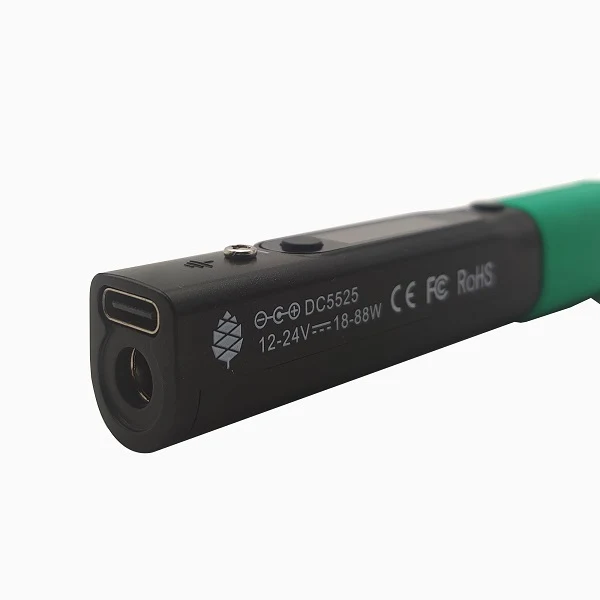 PINE64 Pinecil V2 USB-C smart soldering ironImage: PINE64Check price on Amazon
Short answer
Pick the tip system first, then a station that runs it from a 110-120 V supply.[1] For most home benches that means a cartridge station that takes T12-format or C245-compatible tips, or a USB-C smart iron if you also solder away from the bench. Before you pay, check three things on the exact variant: its voltage, its grounding and who is really selling it.
Picks that fitAll picks and how to choose
- Weller WE1010NA digital soldering station, 70 W, 120 VCheck price on Amazon
- PINE64 Pinecil V2 USB-C smart soldering ironImage: PINE64Check price on Amazon
What a soldering station does
A station is a temperature-controlled iron with its own control unit and stand. Two of our three station picks use cartridge tips. Hakko describes its T12 cartridge as a tip with the heating element and sensor built in, and credits that design with faster thermal response and recovery.[2]
Other stations heat a separate tip with an element inside the iron. Hakko's current FX-888DX works like this: its FX-8801 iron has a ceramic heater and takes T18 tips, and American Hakko rates the station at 100 W on 120 VAC.[3] The FX-888D it replaced is marked discontinued on Hakko's global site.[4] Weller's WE1010NA is a 120 V station of this kind: its 70 W WEP 70 iron takes Weller's ET tips, and Weller lists a 200-850 °F range and calls the station ESD safe.[5]
Picks that fit1 product
Choose the WE1010NA (120 V, 70 W WEP 70 iron). It takes Weller ET tips, not Hakko T18 tips, so buy spare tips in the ET range.
More on choosing
On Amazon, check that 'Ships from / Sold by' shows Amazon.com or Weller before you buy.
Maker-documented 120 V station (Weller ET tips)
USB-C smart irons are the third option. Pine64 rates the Pinecil V2 for USB-C Power Delivery at 12-20 V and for DC at 12-24 V, up to 88 W at 24 V.[6] Pine64's own Where-to-buy page links an Amazon US listing for it, with the iron and "no tips/accessories".[7]
Picks that fit1 product
Choose the Pinecil V2 (PINECIL-BB2) on the Amazon listing Pine64 links. Pine64 says it has no tips or accessories, so add a USB-C PD charger (Pine64 recommends 65 W or more for its short tips).
More on choosing
On Amazon, check that 'Ships from / Sold by' shows Amazon.com or Pine64, and run Pine64's authenticity checker when it arrives.
PINE64 Pinecil V2 USB-C smart soldering iron
The decisions that matter
Tip system first. Tips fit only the handles their system was made for, so this choice outlasts the station. The T12 vs C245 guide compares the two most common systems, and the tip system finder shows what each one fits.
Match power to the work, not the biggest number. JBC rates its precision T210 handle at 40 W peak for medium-power work and its general-purpose T245 handle at 150 W peak for jobs that include ground planes.[8][9] Those figures describe JBC's own handles, not compatible handles sold by other brands.
Station or smart iron. A station suits a fixed bench and long sessions. A USB-C iron packs away, but its power depends on the supply: Pine64's own example shows the same standard tip giving 50 W at 20 V and 72 W at 24 V.[10]
Room to grow. Some stations run more than one handle size, so you can add a finer handle later. AiXun, for example, lists stations that drive T245, T210 and T115-format handles.[11]
What to check for 120 V and safety
- The exact voltage variant. The US Department of Energy gives US household power as 110-120 V at 60 Hz.[1] One model name can hide several mains versions: Weller sells 120 V and 230 V versions of its WE1010 kit, and JBC sells its CDB station as the CD-1BQF for 120 V and the CD-2BQF for 230 V.[12][13] Choose the variant labeled 110 V, 120 V or 110-120 V.
- Grounding. Hakko and JBC publish tip-to-ground resistance under 2 ohms and tip-to-ground potential under 2 mV for their stations.[3][13] Few marketplace listings give these figures. Treat a missing figure as unknown, and prefer a grounded three-prong plug.
- The seller. American Hakko tells buyers to use authorized distributors and warns that counterfeits can carry the Hakko logo.[14] It also says sellers outside the US and Canada are most likely not selling product made for North America.[15] Pine64 says no genuine Pinecils are sold on AliExpress,[16] and its Where-to-buy page names the channels it does use.[7] On Amazon, check who is named under "Ships from / Sold by", not just the brand in the title.
How to choose
- Pick the system from your work. General repair points to C245-compatible or T12-format tips. Fine surface-mount work under magnification points to C210, or C115 for the smallest parts. Work away from the bench points to a USB-C iron.
- Shortlist stations with an explicit 110-120 V variant and a US plug.
- Check grounding information and the seller before you pay.
- Order a second tip shape in the same system at the same time.
Our three station picks for a 120 V bench and the KSGER T12 vs YIHUA 982-III comparison apply this method to real listings. The AliExpress buyer's checklist covers the purchase itself.
Everything in this topic
Guides
- Pinecil vs TS101Helps you choose between the Pinecil V2 and TS101 USB-C irons, and buy a Pinecil through the channel Pine64 names rather than one it says cannot be genuine.
- Why ground planes are hard to solderShows which fix to try first on a stubborn ground joint, and when the answer is a more powerful handle or a preheater rather than a higher setting.
Comparisons
- KSGER T12 V3.1S vs YIHUA 982-IIIShows the practical difference between the two stations: mainly the tip system, and how clearly each listing identifies a 120 V version.
Shortlists
- Soldering stations for a 120 V home benchNarrows the choice to three stations with US voltage options and explains the tip-system and seller trade-offs.
Common questions
Is the KSGER Official Store on AliExpress run by KSGER?
We could not confirm it. A store with that name exists, and an EEVblog forum post links to it, but we found no KSGER-controlled website that confirms who runs it. We call it a store named KSGER Official Store, not a brand-official store. More in KSGER T12 V3.1S vs YIHUA 982-III
Does the YIHUA 982-III work on 120 V?
The YIHUA-branded spec page rates it for 110-240 V, and the seller describes both of its variants as 120 V with a US plug. Choose one of those variants; the spec page's ownership is not independently confirmed, so check the rating on the unit when it arrives. More in KSGER T12 V3.1S vs YIHUA 982-III
Does the YIHUA 982-III take C245 tips?
The seller sells a 'C245 set' variant, but the YIHUA-branded spec page we found lists only C115 and C210 handle packages. Treat C245 as the seller's description and check the handle shown on the listing before you order tips. More in KSGER T12 V3.1S vs YIHUA 982-III
Are the KSGER station's T12 tips made by Hakko?
Treat them as T12-format tips, not Hakko parts. Hakko sells its genuine cartridges in North America under T15 part numbers and warns that counterfeits can carry its logo. More in KSGER T12 V3.1S vs YIHUA 982-III
Which station is better for ground planes and big connectors?
Neither listing publishes enough to say. JBC designs its own C245 system for high-power work such as ground planes, but its ratings do not transfer to compatible handles. For any station, SparkFun suggests a larger tip, more heat and extra flux on ground planes. More in KSGER T12 V3.1S vs YIHUA 982-III
Where can I buy a genuine Pinecil?
Through a channel Pine64 names. Its Where-to-buy page links an Amazon US listing as its 'Amazon-USA official pine64 store', with the Pinecil V2 and no tips or accessories; check that Amazon.com or Pine64 is the seller. Pine64 says no genuine Pinecils are sold on AliExpress. More in Pinecil vs TS101
Do the Pinecil and TS101 use the same tips?
Both are documented with TS100-style tips: Pine64 for the Pinecil V2, and Oscar Liang's review for the TS101. Pine64 does not mention TS101-branded tips, so do not assume those fit a Pinecil. More in Pinecil vs TS101
What charger do I need for a Pinecil V2?
A USB-C PD charger. Pine64 recommends at least 65 W (3.25 A at 20 V), or a higher-voltage supply, when using its short tips. You do not need a 100 W charger. More in Pinecil vs TS101
Questions
Is a higher-wattage soldering station always better?
No. Power ratings follow the job: JBC rates its precision T210 handle at 40 W peak and its general-purpose T245 handle at 150 W peak. Choose the tip system for the work you do, then a station that runs it.[8][9]
Can I use a 220 V soldering station in the US?
Choose the 110-120 V variant instead. US household power is 110-120 V at 60 Hz, and makers such as Weller sell separate 120 V and 230 V versions of the same station. Do not rely on a plug adapter.[1][12]
Is the Hakko FX-888D still made?
Hakko's global site marks the FX-888D as discontinued. Its successor, the FX-888DX, still takes T18 tips on its FX-8801 iron and is rated 100 W at 120 VAC by American Hakko.[4][3]
How long does a soldering station take to heat up?
It depends on the design. Weller quotes about 28 seconds from 50 to 350°C for its WE1010NA station, and Tom's Hardware timed a Pinecil V2 at 10 seconds to working temperature (one unit, its own method).[17][18]
Are the Pinecils sold on AliExpress genuine?
Pine64 says no: it states that no Pine64 Pinecils are sold on AliExpress and that it has no authorized resellers there. Its Where-to-buy page links an Amazon US listing instead, and genuine units bought after August 2, 2022 should pass Pine64's online authenticity checker.[16][7]